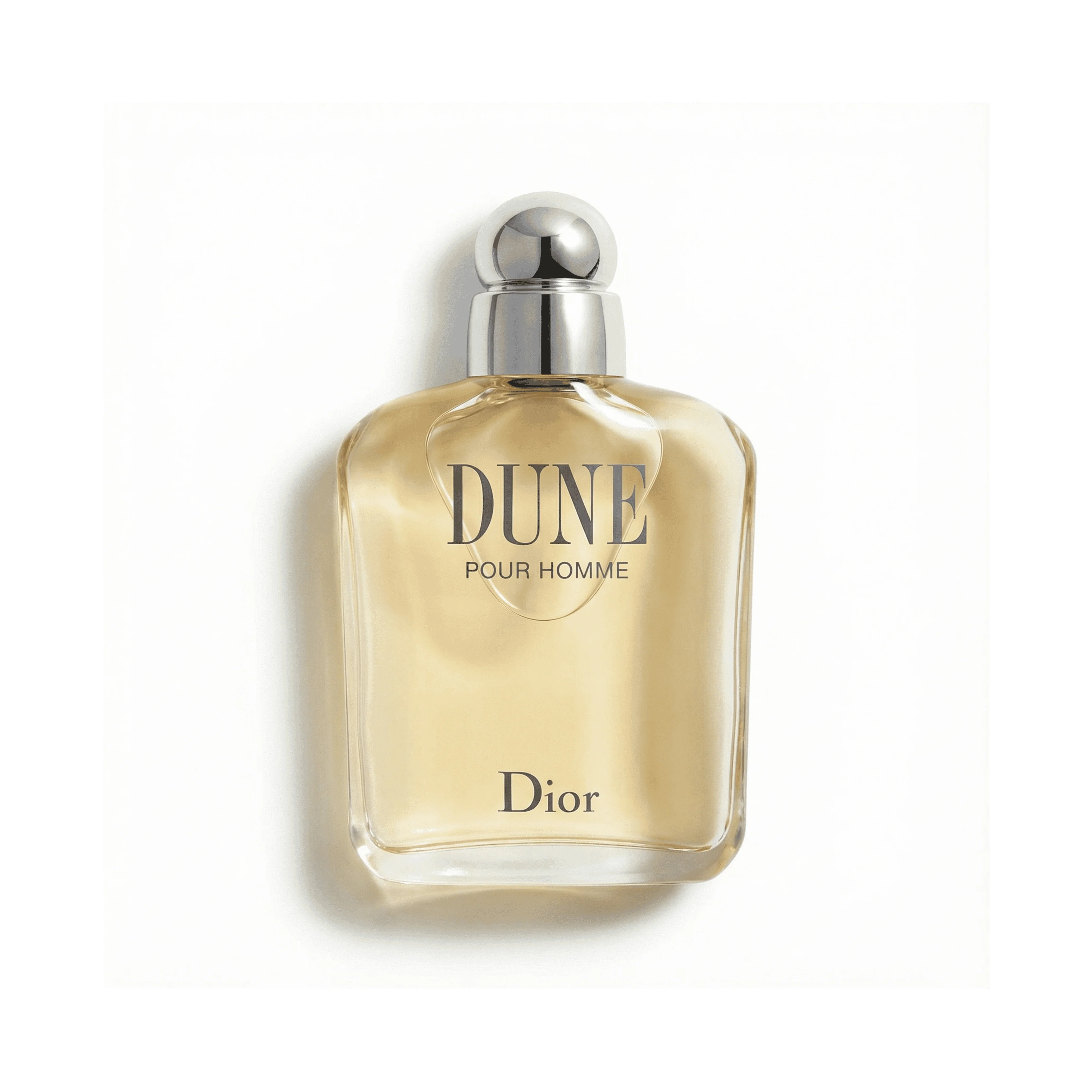
Dune Pour Homme
Few fragrances capture a specific mood as precisely as Christian Dior Dune Pour Homme Eau de Toilette, released in 1997 as the masculine counterpart to the iconic women's Dune. It is named for a landscape, and it smells like one: windswept, arid, alive with green bitterness and a quiet warmth beneath. Aromatica carries the Dior Dune Pour Homme decant in Bangladesh in all available sizes, so you can spend time with this quietly unusual fragrance and decide if the full bottle is right for you.
Fragrance Notes
Top: Fig Leaf, Cassis, Sage, Basil
Heart: Fig Wood Bark, Rose, Mignonette
Base: Sandalwood, Cedar, Tonka Bean, Vanilla
The Scent
Fig leaf and cassis open the fragrance with an immediacy that feels almost confrontational. This is not a gentle, milky fig like some niche interpretations. It is green, bitter, and resinous, the smell of the leaf and the sap rather than the fruit. Basil and sage amplify this herbaceous sharpness, pulling the opening firmly into aromatic territory. There is a facet to the cassis here that skews more tart than fruity, less blackcurrant cordial and more the raw berry on the vine, shot through with something vaguely resinous and sharp. On first spray there is a brightness to it, almost citric without actually being citrus, a kind of clean natural bite that is distinctly 1990s in its sensibility. Within the first fifteen minutes, this phase is at its most intense, and it reads as genuinely unusual by modern standards. It can read immediately appealing or a touch harsh depending on skin chemistry and what you are accustomed to, and that variability is worth knowing before you try it. The fig note in particular can divide people: those expecting something smooth and creamy are caught off guard by how raw and green it reads here. It can come across as sweet or sharp depending on who is wearing it and what is sitting underneath.
As the opening softens, fig wood bark begins to surface, adding a dry, slightly dusty quality that bridges the sharp green top and the warmer base. This is the point where the dune imagery starts to make sense: the moisture evaporates and what remains is dry, warm structure. The fig note does not disappear here so much as change character, losing the raw edge of the leaf and taking on the quieter, more settled quality of the wood itself. It is less a fragrance that shouts its name and more one that gradually reveals it. Rose and mignonette appear in the heart, not as soft florals but as background texture, lending a faint powdery sweetness that keeps the aromatic core from becoming too austere. Mignonette is an underused note in modern perfumery, and its inclusion here feels deliberate: it reads as something between a soft floral and a slightly green herbal, amplifying the freshness of the composition without tilting it into conventional fougere territory. The transition from top to heart feels smooth rather than abrupt, the kind of shift you notice only in retrospect, when you realize the sharp green has receded and something warmer has taken its place.
Into the dry-down, sandalwood and cedar provide a familiar woody foundation, slightly dry and clean. Tonka bean and vanilla arrive last and quietly, rounding the composition rather than sweetening it outright. The base on skin carries a warm, understated creaminess that is never loud. This is a fragrance that becomes more approachable over time, softer and more refined as the green opening yields to the warmer woody accord underneath. At full dry-down, what you are left with is something close to skin: a clean woody warmth with a trace of the herbal sharpness that started everything. It does not transform into something unrecognizable from its opening. The through-line of greenness and dryness persists all the way, which is part of what makes it coherent as a composition.
When to Wear
Dune Pour Homme is best suited to autumn and cooler winter days, when the aromatic herbaceous character feels grounded rather than sharp. It works well in professional or semi-formal settings where something distinctive but restrained is appropriate, a boardroom, a dinner, or a slow weekend afternoon with nowhere particular to be.
Who Is It For
Anyone who gravitates toward green aromatics and understated classics, who finds most modern fragrances too sweet or too safe, and who enjoys a scent with genuine character that reveals itself slowly rather than announcing itself loudly will find this worth exploring.
If you enjoy Green Irish Tweed, the aromatic green lineage puts them in close conversation. You can also browse the broader Aromatic Herbs collection and the full Dior collection at Aromatica.
Available as an authentic decant in Bangladesh at Aromatica in 3ml, 5ml, 9ml, and 15ml.
Original: $2,243.00
-65%$2,243.00
$785.05Product Information
Product Information
Shipping & Returns
Shipping & Returns
Description
Few fragrances capture a specific mood as precisely as Christian Dior Dune Pour Homme Eau de Toilette, released in 1997 as the masculine counterpart to the iconic women's Dune. It is named for a landscape, and it smells like one: windswept, arid, alive with green bitterness and a quiet warmth beneath. Aromatica carries the Dior Dune Pour Homme decant in Bangladesh in all available sizes, so you can spend time with this quietly unusual fragrance and decide if the full bottle is right for you.
Fragrance Notes
Top: Fig Leaf, Cassis, Sage, Basil
Heart: Fig Wood Bark, Rose, Mignonette
Base: Sandalwood, Cedar, Tonka Bean, Vanilla
The Scent
Fig leaf and cassis open the fragrance with an immediacy that feels almost confrontational. This is not a gentle, milky fig like some niche interpretations. It is green, bitter, and resinous, the smell of the leaf and the sap rather than the fruit. Basil and sage amplify this herbaceous sharpness, pulling the opening firmly into aromatic territory. There is a facet to the cassis here that skews more tart than fruity, less blackcurrant cordial and more the raw berry on the vine, shot through with something vaguely resinous and sharp. On first spray there is a brightness to it, almost citric without actually being citrus, a kind of clean natural bite that is distinctly 1990s in its sensibility. Within the first fifteen minutes, this phase is at its most intense, and it reads as genuinely unusual by modern standards. It can read immediately appealing or a touch harsh depending on skin chemistry and what you are accustomed to, and that variability is worth knowing before you try it. The fig note in particular can divide people: those expecting something smooth and creamy are caught off guard by how raw and green it reads here. It can come across as sweet or sharp depending on who is wearing it and what is sitting underneath.
As the opening softens, fig wood bark begins to surface, adding a dry, slightly dusty quality that bridges the sharp green top and the warmer base. This is the point where the dune imagery starts to make sense: the moisture evaporates and what remains is dry, warm structure. The fig note does not disappear here so much as change character, losing the raw edge of the leaf and taking on the quieter, more settled quality of the wood itself. It is less a fragrance that shouts its name and more one that gradually reveals it. Rose and mignonette appear in the heart, not as soft florals but as background texture, lending a faint powdery sweetness that keeps the aromatic core from becoming too austere. Mignonette is an underused note in modern perfumery, and its inclusion here feels deliberate: it reads as something between a soft floral and a slightly green herbal, amplifying the freshness of the composition without tilting it into conventional fougere territory. The transition from top to heart feels smooth rather than abrupt, the kind of shift you notice only in retrospect, when you realize the sharp green has receded and something warmer has taken its place.
Into the dry-down, sandalwood and cedar provide a familiar woody foundation, slightly dry and clean. Tonka bean and vanilla arrive last and quietly, rounding the composition rather than sweetening it outright. The base on skin carries a warm, understated creaminess that is never loud. This is a fragrance that becomes more approachable over time, softer and more refined as the green opening yields to the warmer woody accord underneath. At full dry-down, what you are left with is something close to skin: a clean woody warmth with a trace of the herbal sharpness that started everything. It does not transform into something unrecognizable from its opening. The through-line of greenness and dryness persists all the way, which is part of what makes it coherent as a composition.
When to Wear
Dune Pour Homme is best suited to autumn and cooler winter days, when the aromatic herbaceous character feels grounded rather than sharp. It works well in professional or semi-formal settings where something distinctive but restrained is appropriate, a boardroom, a dinner, or a slow weekend afternoon with nowhere particular to be.
Who Is It For
Anyone who gravitates toward green aromatics and understated classics, who finds most modern fragrances too sweet or too safe, and who enjoys a scent with genuine character that reveals itself slowly rather than announcing itself loudly will find this worth exploring.
If you enjoy Green Irish Tweed, the aromatic green lineage puts them in close conversation. You can also browse the broader Aromatic Herbs collection and the full Dior collection at Aromatica.
Available as an authentic decant in Bangladesh at Aromatica in 3ml, 5ml, 9ml, and 15ml.