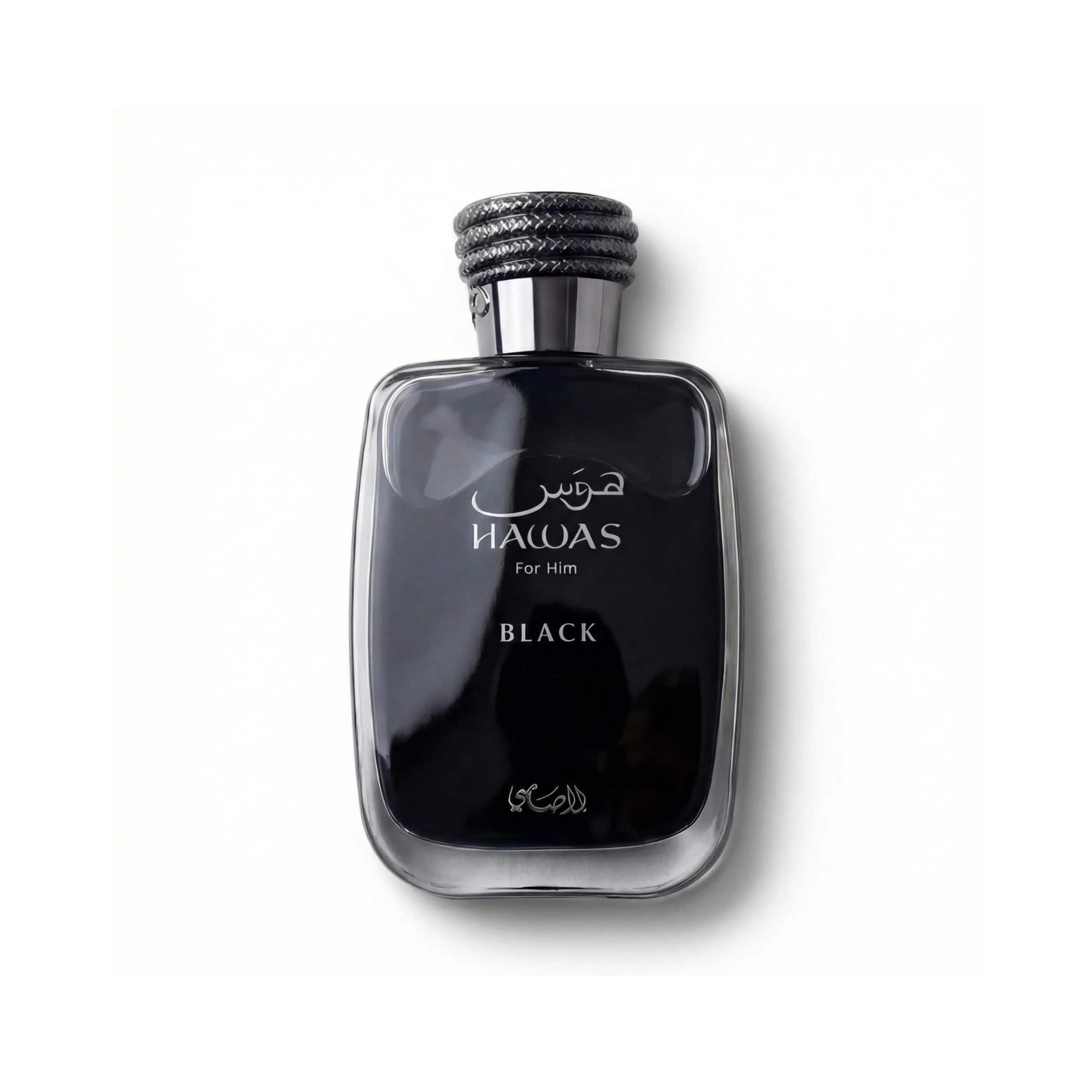
Hawas Black
Hawas Black is Rasasi's darker answer to the pineapple-meets-moss formula that took the fragrance world by storm. Released in 2024 as an Eau de Parfum and part of the sprawling Hawas line built on the DNA of the original Hawas for Him, it takes that familiar blueprint and drags it somewhere murkier and more brooding. Aromatica carries the Rasasi Hawas Black decant in Bangladesh in all available sizes, so you can test it properly.
Fragrance Notes
Top: Bergamot, Pineapple, Grapefruit
Heart: Patchouli, Cedarwood, Jasmine
Base: Oakmoss, Woody Notes, Amber
The Scent
Pineapple announces itself immediately and with confidence. That ripe, almost candied tropical sweetness has become the calling card of this entire genre, and here it lands loud and unapologetic. Bergamot sharpens the edges right away, keeping the pineapple from tipping into dessert territory, and grapefruit adds a slightly bitter, zesty backbone that makes the whole opening feel alive rather than cloying. Within the first few minutes, the citrus and the fruit are working together in that familiar Hacivat-adjacent register, and the comparison is hard to argue with. The bergamot does more than brighten the accord; it gives the pineapple a clean, slightly aromatic lift that keeps the opening from reading as purely tropical. Grapefruit threads through both, its pale bitterness preventing any single element from dominating too early and lending the top a pleasing tension between sweet and tart.
What separates Hawas Black from its lighter cousins is what happens around the ten-to-fifteen minute mark. Darker patchouli starts rising through the citrus, not the dusty vintage patchouli of old-school orientals but a damp, earthier version that gives the whole composition an almost smoky quality. It is the note that earns the "Black" designation and makes the fragrance feel more serious than the original Hawas. Jasmine appears alongside it but plays a supporting role, adding a quiet floral depth that prevents the heart from feeling entirely austere.
Cedarwood arrives in the mid-development, dry and slightly resinous, anchoring the patchouli and keeping the structure from going too sweet or too earthy. The balance here is genuinely well-executed. As the fragrance moves into the dry-down, the oakmoss becomes more prominent, bringing that classic chypre-adjacent quality, a slightly green and mossy coolness that sits under the warm amber foundation. The amber in the base is not heavy or gourmand; it reads as a warm mineral glow rather than a sugary resin. The overall effect in the dry-down is a woody, mossy, smoky skin scent that has shed most of the tropical brightness of the opening. That progression, from bright citrus fruit down to dark earth and moss, is the whole point of this fragrance, and it executes the arc with more intentionality than many clones in this space.
Hawas Black sits extremely close to Nishane Hacivat in its overall character, with the similarity running deep across all three stages of development. Where impressions diverge is on the question of refinement: the patchouli can read as slightly more aggressive and the transitions a little less polished than in Hacivat, while on other skin types it can be indistinguishable at arm's length. That slight roughness in the heart is worth knowing about, and the patchouli specifically can read as heavier depending on skin chemistry, so the experience is not entirely uniform across wearers. If you run warm or find earthy notes amplify on your skin, that is a factor worth considering.
When to Wear
Hawas Black performs best in cooler weather, from early autumn through winter, when the dark patchouli and oakmoss come into their own rather than feeling heavy. It suits evening and night-time settings, a dinner out or a social gathering, where you want a fragrance with presence and character rather than something polite and forgettable.
Who Is It For
Anyone who has admired Nishane Hacivat or Creed Aventus but wants to explore that pineapple-citrus-moss space without the niche price tag will find Hawas Black a compelling entry point, especially for those who specifically want a darker, moodier take on the formula rather than a bright, optimistic one.
If you enjoy Hawas for Him, the original sits in the same family and is worth comparing side by side to understand how much the patchouli and oakmoss shift the character. Browse the full Rasasi collection at Aromatica.
Available as an authentic decant in Bangladesh at Aromatica in 3ml, 5ml, 9ml, and 15ml.
Original: $340.00
-65%$340.00
$119.00Product Information
Product Information
Shipping & Returns
Shipping & Returns
Description
Hawas Black is Rasasi's darker answer to the pineapple-meets-moss formula that took the fragrance world by storm. Released in 2024 as an Eau de Parfum and part of the sprawling Hawas line built on the DNA of the original Hawas for Him, it takes that familiar blueprint and drags it somewhere murkier and more brooding. Aromatica carries the Rasasi Hawas Black decant in Bangladesh in all available sizes, so you can test it properly.
Fragrance Notes
Top: Bergamot, Pineapple, Grapefruit
Heart: Patchouli, Cedarwood, Jasmine
Base: Oakmoss, Woody Notes, Amber
The Scent
Pineapple announces itself immediately and with confidence. That ripe, almost candied tropical sweetness has become the calling card of this entire genre, and here it lands loud and unapologetic. Bergamot sharpens the edges right away, keeping the pineapple from tipping into dessert territory, and grapefruit adds a slightly bitter, zesty backbone that makes the whole opening feel alive rather than cloying. Within the first few minutes, the citrus and the fruit are working together in that familiar Hacivat-adjacent register, and the comparison is hard to argue with. The bergamot does more than brighten the accord; it gives the pineapple a clean, slightly aromatic lift that keeps the opening from reading as purely tropical. Grapefruit threads through both, its pale bitterness preventing any single element from dominating too early and lending the top a pleasing tension between sweet and tart.
What separates Hawas Black from its lighter cousins is what happens around the ten-to-fifteen minute mark. Darker patchouli starts rising through the citrus, not the dusty vintage patchouli of old-school orientals but a damp, earthier version that gives the whole composition an almost smoky quality. It is the note that earns the "Black" designation and makes the fragrance feel more serious than the original Hawas. Jasmine appears alongside it but plays a supporting role, adding a quiet floral depth that prevents the heart from feeling entirely austere.
Cedarwood arrives in the mid-development, dry and slightly resinous, anchoring the patchouli and keeping the structure from going too sweet or too earthy. The balance here is genuinely well-executed. As the fragrance moves into the dry-down, the oakmoss becomes more prominent, bringing that classic chypre-adjacent quality, a slightly green and mossy coolness that sits under the warm amber foundation. The amber in the base is not heavy or gourmand; it reads as a warm mineral glow rather than a sugary resin. The overall effect in the dry-down is a woody, mossy, smoky skin scent that has shed most of the tropical brightness of the opening. That progression, from bright citrus fruit down to dark earth and moss, is the whole point of this fragrance, and it executes the arc with more intentionality than many clones in this space.
Hawas Black sits extremely close to Nishane Hacivat in its overall character, with the similarity running deep across all three stages of development. Where impressions diverge is on the question of refinement: the patchouli can read as slightly more aggressive and the transitions a little less polished than in Hacivat, while on other skin types it can be indistinguishable at arm's length. That slight roughness in the heart is worth knowing about, and the patchouli specifically can read as heavier depending on skin chemistry, so the experience is not entirely uniform across wearers. If you run warm or find earthy notes amplify on your skin, that is a factor worth considering.
When to Wear
Hawas Black performs best in cooler weather, from early autumn through winter, when the dark patchouli and oakmoss come into their own rather than feeling heavy. It suits evening and night-time settings, a dinner out or a social gathering, where you want a fragrance with presence and character rather than something polite and forgettable.
Who Is It For
Anyone who has admired Nishane Hacivat or Creed Aventus but wants to explore that pineapple-citrus-moss space without the niche price tag will find Hawas Black a compelling entry point, especially for those who specifically want a darker, moodier take on the formula rather than a bright, optimistic one.
If you enjoy Hawas for Him, the original sits in the same family and is worth comparing side by side to understand how much the patchouli and oakmoss shift the character. Browse the full Rasasi collection at Aromatica.
Available as an authentic decant in Bangladesh at Aromatica in 3ml, 5ml, 9ml, and 15ml.